Project Spotlight: Primary Bath by Farmhouse Fixer’s Kristina Crestin
This Woodland Wonder Primary Bath by Farmhouse Fixer’s Kristina Crestin Looks Like It’s Been Here for 200 Years
“How do you feel about a black bathroom?”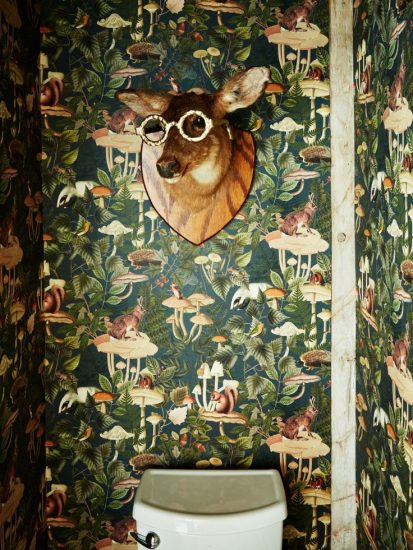
It’s not a question designer Kristina Crestin asks often—most clients aren’t bold enough to say yes. But when she posed it to a pair of New England creatives renovating a 200-year-old farmhouse in Candia, New Hampshire for HGTV’s Farmhouse Fixer, their answer surprised and delighted her.
“The wife said, ‘I’m not scared of a black wall. I like color, texture and woodland creatures,’” Crestin recalls with a chuckle. That unexpected moment of openness would go on to shape the entire aesthetic direction of the historic homestead that Crestin brought back to life with her Farmhouse Fixer co-star, Jonathan Knight.
The couple—he, a shoe designer; she, a graphic designer—had purchased the rural property for its acreage, charm, and a slower pace of life surrounded by a coterie of animals that includes ducks, dogs, and chickens. “They really leaned into the idea of restoring this old home and wanted to physically be a part of the project,” Crestin says. “They did a lot of work themselves. They were design-oriented and absolutely fearless.”
Reclaiming Space for a Primary Suite
Given the home’s age, the original floorplan lacked a true primary suite. Crestin had her work cut out for her in carving out a modern layout that felt intentional and seamlessly integrated.
The new bathroom space she had in mind had previously been a street-facing parlor on the first floor—a pass-through room the couple had been using as an office. “Three rooms were stacked in the front—a bedroom, the foyer with the front staircase in the middle and the parlor to the side,” remembers Crestin.“Everyone expected the primary bath to be in the rear. But I had this idea in my head, inspired by some of the wife’s British-inspired Pinterest images.”
She proposed a new floorplan: they would remove the original front staircase to make more room for a primary bath with a soaking tub at the center, seemingly floating in front of the original brick fireplace. “I wanted it to feel like a room rather than a bath,” says Crestin.
It was an instant yes.
Celebrating the Craft of a 200-Year-Old Home
During demolition, the design vision only deepened—thanks in large part to the husband, who took on the demo work himself. “When he pulled down the ceilings, hundreds of old corn cobs came pouring out,” recalls Crestin. “They were sometimes used as insulation hundreds of years ago. And when we opened up the structure, we found the original joists and floorboards, with bark still visible on them. We all got so excited. It was this tangible reminder that these homes were literally built from trees on the land.”
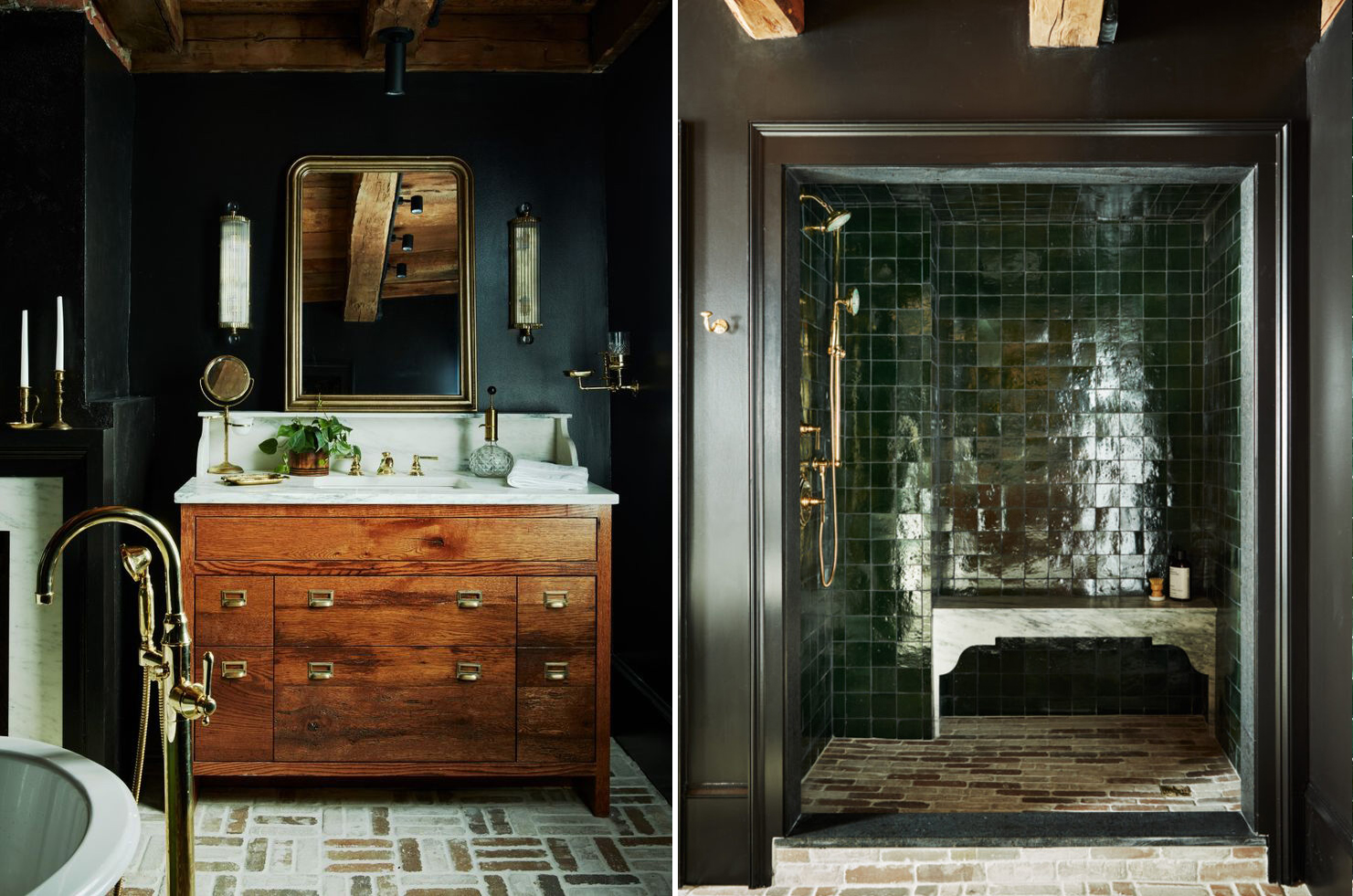
The team decided to honor those discoveries. Patterned brick floors were added, while the original wood planks were carefully removed and reused elsewhere. Even the non-functional brick fireplace was left intact. “We decided to leave it all exposed,” says Crestin. “My clients fully embraced the imperfections and rawness of the original materials. I even warned them, ‘Brick floors are hard to clean!’ But they were absolutely fearless.”
That spirit of authenticity and connection to place carried over into aesthetic decisions. The rugged mountains of southern New Hampshire became the inspiration for her color palette — a moody mix of forested greens, blacks, woods and brick. “I wanted to have these moments of color unfolding,” says Crestin

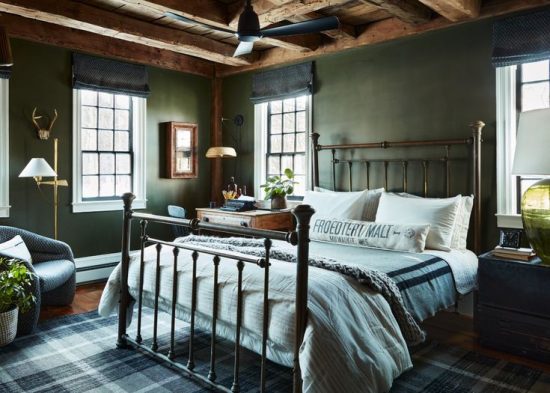
The layout made the element of discovery possible. To access the new bath space, you pass through the bedroom with its wood floors and deep yellow-green walls. From there, a custom dressing room—designed to evoke an old-fashioned general store with reclaimed textures and earthy details—creates a richly layered transition. Then the bath reveals itself in a deep-hued flourish: striking black walls, bark-textured accents, warm brick underfoot, and a moss green freestanding tub by Hydro Systems at the heart. The wife got her woodland wonder.
A Freestanding Tub That Could Have Always Been There
“I didn’t want a clawfoot tub, but I needed something classic—something that felt like it could have been here from the beginning,” says Crestin. She landed on the Château tub by Hydro Systems with its elegant bateau shape set on a pedestal. The moss green finish (one of Hydro Systems’ 15 standard colors) pulled together all the surrounding tones: the green zellige shower tile and the bedroom hues. “I knew the tub needed to feel special. That soft green gave a subtle nod to the nature surrounding the farmhouse, but it also made it feel special.”
Rather than tucking the tub in a corner or along a wall, Crestin placed it front and center, directly in front of the brick fireplace. “It became the star,” she says. “But it also solved a few design challenges for me—freeing up the walls for windows and vanities, and preserving clean sightlines.”
Juxtaposed with the black walls and warm brick textures, the tub’s moss green finish transforms it into a striking focal point. Crestin is convinced that drenching the space in color was the right move. “If you want to relax, you don’t need bright light reflecting off pale surfaces,” she says. “You need depth. You need texture.”

Layering Old and New
Every material choice told a story. The fireplace—original, though not yet functional—anchored the space with subtle drama. The tub’s white overflow visually disappeared, while an unlacquered brass tub filler was selected to patina over time, adding age and richness. “There was no indoor plumbing when this house was built, so we let go of the question, ‘What era is this?’ and focused instead on choosing elements that simply felt right for the space.”
Crestin kept the antique rippled glass windows and existing pocket shutters for privacy. Custom reclaimed oak vanities, made by a local cabinetmaker, were paired with antique hardware and a marble backsplash with a delicate built-in ledge—“a little nod to old dresser tops,” she says.
Lighting was another key layer: deco-inspired sconces, track heads discreetly tucked into the ceiling joists, and art lights showcasing a moody, oversized painting by the homeowner himself for a personal touch.
The result is a space that feels more like a curated retreat than a typical bathroom.
A Woodland Bath That Feels Like a Boutique Inn
More than a year later, the clients still rave about their woodland-inspired sanctuary. “We’ve become friends now, and they tell me it feels like they’re at an inn,” Crestin says. “Like they’ve been transported somewhere else entirely—and that’s the best compliment I could receive.”
The wife especially treasures the tub. “She told me, ‘It’s the most decadent thing, having my bathtub right in the middle of the room. I feel sexy in this space,’” Crestin shares.
The episode—which aired last spring—remains one of Farmhouse Fixer’s most memorable. Not because it followed convention, but because the clients were willing to defy it. “Most people say, ‘That’s badass—but I could never do a black wall,’” Crestin says of the reactions she’s received. “But last season, viewers really responded to seeing something different. It’s so easy for design to start looking the same—homeowners are constantly fed the same images and begin to think that’s what they want. That’s what made this project such a refreshing challenge: I had clients who weren’t afraid to take risks.”
Photography: Jared Kuzia